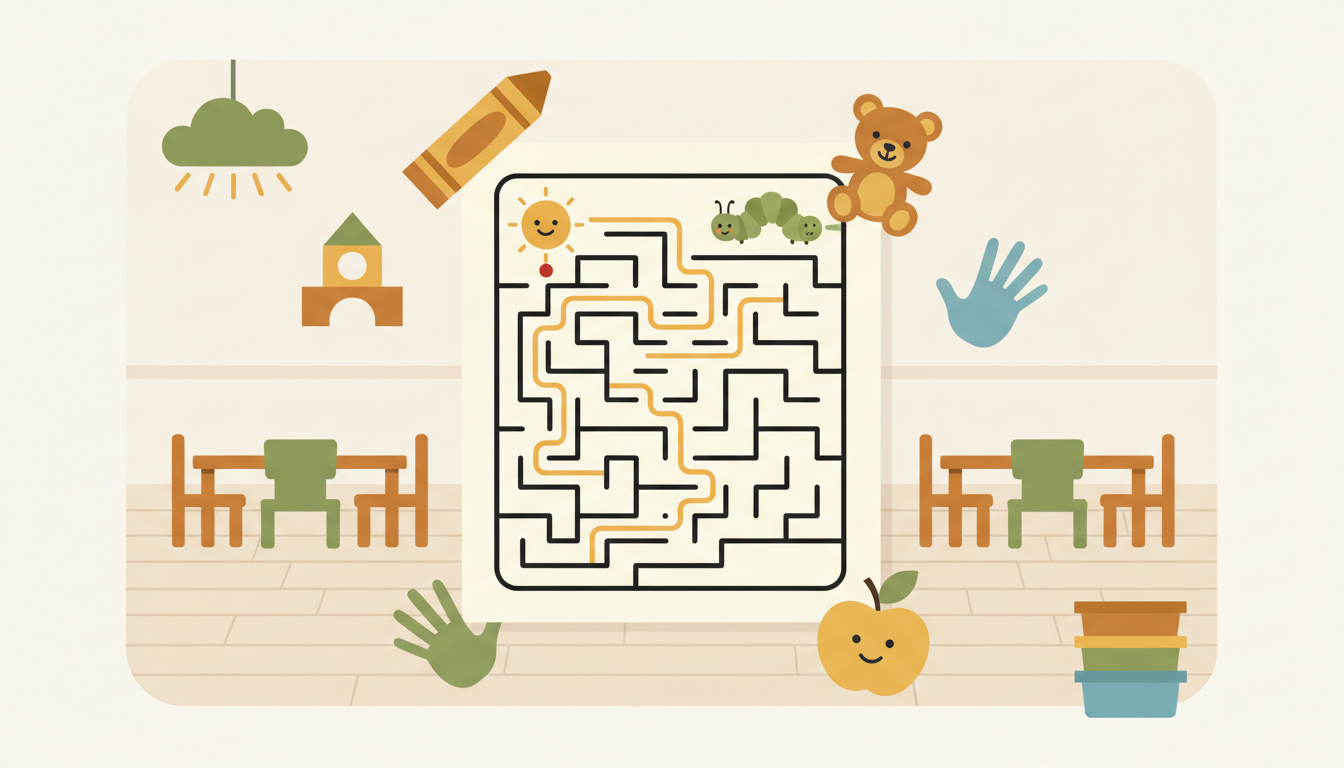
Why Printable Mazes Are Essential for Early Childhood Education
Research-backed insights on how printable maze activities support pre-K and kindergarten learning goals. Includes free worksheets and teaching strategies.
The Science Behind Mazes in Early Learning
According to research published in the Journal of Cognitive Development, maze activities engage multiple brain regions simultaneously, making them one of the most efficient "brain training" tools for children ages 3-7.
5 Learning Domains Mazes Support
1. Executive Function Skills
Mazes require children to plan, monitor progress, and adjust strategies—the core components of executive function. A 2022 study from Stanford found that children who regularly completed maze activities showed 23% improvement in planning tasks compared to a control group.
2. Pre-Writing Skills
The pencil control required to navigate narrow paths directly translates to handwriting. Occupational therapists often prescribe maze activities as part of pre-writing curriculums.
3. Spatial Reasoning
Understanding "left," "right," "forward," and "backward" becomes concrete when navigating a maze. This spatial vocabulary is foundational for later math learning, particularly geometry.
4. Visual Discrimination
Spotting the difference between a dead-end and an open path trains the visual discrimination skills needed for reading (distinguishing 'b' from 'd', for example).
5. Delayed Gratification
The time between starting a maze and reaching the reward (the exit) teaches patience—a predictor of academic success according to the famous "Marshmallow Test" research.
How to Integrate Printable Mazes into Your Curriculum
Morning Arrival Activity
Place a simple maze at each child's seat as they arrive. This settles the class and provides a calm transition into the school day.
Literacy Connection
Create mazes where children must "collect" letters to spell a word as they solve the puzzle. For example, the path goes through letters T-R-E-E to spell "tree."
Math Integration
Design mazes where the correct path is determined by counting (e.g., "Take the path with 5 apples, not 4").
Science Exploration
Use animal-themed mazes to teach habitats ("Help the bee find the flower," "Guide the fish to the coral reef").
Differentiation Strategies
For Advanced Learners: Provide mazes with no visual start/end markers—they must infer the solution.
For Struggling Students: Use colored "hint paths" that fade out partway through.
For English Language Learners: Label maze elements in both English and home language.
Free Resources for Teachers
At MazeDIY, we offer free educational maze templates aligned with common pre-K and kindergarten standards. Filter by skill (fine motor, problem-solving, etc.) and print unlimited copies for your classroom.
Parent Communication Tips
Send mazes home with a note explaining the educational benefits. Many parents see mazes as "just fun," so highlighting the learning goals increases home-school connection.
Assessment Ideas
Use mazes as informal assessments:
- Pencil Grip: Observe how children hold the pencil while tracing.
- Frustration Tolerance: Note how they respond to dead ends.
- Strategy Use: Do they plan ahead or use trial-and-error?
Conclusion
Printable mazes are more than time-fillers—they're evidence-based learning tools that support multiple developmental domains. By integrating them thoughtfully into your curriculum, you can make learning engaging and effective.
Related Topics
Ready to try it yourself?
Create your own custom maze in seconds with our free generator.
Create Maze Now